About Supply Chain Management
Supply Chain management is the process of planning, coordinating, and controlling the flow of goods, services, and information from raw materials to the final customer. It involves key activities such as sourcing materials, manufacturing products, managing inventory, transportation, and delivering items efficiently. Effective supply chain management helps businesses reduce costs, improve product quality, and ensure timely delivery, which increases customer satisfaction. By using technology, strong supplier relationships, and good logistics planning, companies can respond quickly to market demand and remain competitive in today’s global economy.
Core Subjects in the Supply Chain Management Major
Students who study Supply Chain Management gain a strong foundation in business operations, logistics, and strategic decision-making. The major covers a wide range of essential subjects, including:
• Logistics and Transportation: Focuses on the efficient movement of goods, route optimization, warehousing, distribution networks, and different modes of transportation (road, rail, sea, and air).
• Procurement and Sourcing: Covers supplier selection, negotiation, contract management, strategic sourcing, and ethical/global sourcing practices.
• Inventory Management: Teaches techniques for controlling stock levels, demand forecasting, just-in-time (JIT) systems, safety stock calculations, and minimizing carrying costs.
• Operations Management: Explores production planning, process improvement, quality control (such as Six Sigma and Lean), capacity planning, and overall operational efficiency.
• Supply Chain Analytics: Introduces data-driven decision making using tools like predictive analytics, big data, optimization models, and visualization software.
• International Trade and Global Supply Chains: Examines customs regulations, trade agreements, tariffs, Incoterms, currency risks, and managing cross-border supply chains.
• Supply Chain Information Systems and Technology: Covers Enterprise Resource Planning (ERP) systems, Warehouse Management Systems (WMS), Transportation Management Systems (TMS), blockchain, Internet of Things (IoT), and AI applications in supply chains.
• Business Strategy and Risk Management: Focuses on aligning supply chain strategy with overall business goals, resilience planning, disruption management (e.g., pandemics, geopolitical issues), and sustainability practices.
• Sustainability and Green Supply Chain: Addresses environmental impact, circular economy principles, carbon footprint reduction, ethical labor practices, and sustainable sourcing.
• Demand Forecasting and Planning: Involves statistical forecasting methods, sales and operations planning (S&OP), and collaborative planning with suppliers and customers.
Many programs also integrate real-world projects, case studies, simulations, and internships to help students apply these concepts in practical settings. Some advanced courses may include topics like project management, cost accounting in supply chains, e-commerce logistics, and humanitarian supply chain management.
Skills You Will Gain
This major helps students develop a wide range of practical and analytical skills that are highly valued in the job market. Students will gain problem-solving abilities, data analysis skills, and the ability to forecast demand and manage risks. In addition, they will improve communication, teamwork, and negotiation skills, which are essential when working with suppliers, partners, and customers. Time management and decision-making are also key skills developed through this program.
Importance of Supply Chain Management
Supply chain management is essential for the success of any business because it ensures that the right products are delivered to the right place, at the right time, and in the right condition. A well-managed supply chain can significantly reduce operational costs, improve product quality, and increase customer satisfaction.
It also plays a critical role in supporting global trade by connecting suppliers, manufacturers, distributors, and customers across different countries. This allows products to be produced in one part of the world and sold in another efficiently and cost-effectively.
Beyond cost savings and efficiency, effective supply chain management helps businesses build resilience against disruptions (such as natural disasters, geopolitical tensions, or pandemics), respond quickly to changing customer demand, and gain a competitive advantage in the marketplace. In today’s fast-paced and interconnected world, companies with strong supply chains are more agile, sustainable, and profitable.Without effective supply chains, businesses would struggle to compete, maintain consistent product availability, and meet customer expectations.
Career Opportunities in Supply Chain Management
Graduates of Supply Chain Management have a wide range of exciting career options across various industries, including manufacturing, retail, e-commerce, logistics, pharmaceuticals, food and beverage, and technology.
Common roles include:
• Supply Chain Manager – Overseeing the entire supply chain from sourcing to delivery.
• Logistics Coordinator / Manager – Managing transportation, warehousing, and distribution networks.
• Procurement / Sourcing Specialist – Handling supplier selection, negotiations, and contract management.
• Operations Manager – Improving day-to-day production and operational efficiency.
• Inventory Analyst / Manager – Controlling stock levels and optimizing inventory costs.
• Warehouse Supervisor / Manager – Running warehouse operations and ensuring smooth material flow.
• Supply Chain Analyst – Using data and analytics to improve forecasting, planning, and decision-making.
• Demand Planner – Forecasting customer demand and aligning supply with market needs.
• Global Trade Compliance Specialist – Managing international regulations, tariffs, and customs requirements.
• Sustainability Supply Chain Coordinator – Focusing on green logistics and ethical sourcing practices.
These roles involve planning, organizing, optimizing, and continuously improving the flow of goods, information, and services. As companies expand globally and face increasing challenges such as digital transformation, sustainability demands, and supply chain disruptions, the need for skilled supply chain professionals continues to grow rapidly.
This field offers strong job prospects, competitive salaries, excellent opportunities for career advancement, and the chance to work in dynamic, international environments.
Industries That Need Supply Chain Management Graduates
Supply Chain Management is a highly versatile major that is essential in almost every industry. Every business depends on the efficient movement of goods, services, information, and materials, making skilled supply chain professionals valuable across diverse sectors.
Key industries that actively seek Supply Chain Management graduates include:
• Retail and E-commerce – Companies like Amazon, Shopee, and Lazada rely on fast, reliable delivery systems, last-mile logistics, and inventory management to meet customer expectations.
• Manufacturing – Factories need efficient procurement, production planning, and distribution to keep operations running smoothly and reduce costs.
• Transportation and Logistics – Shipping companies, freight forwarders, and third-party logistics (3PL) providers require experts in route optimization, warehousing, and global transportation.
• Healthcare and Pharmaceuticals – Hospitals, clinics, and drug manufacturers depend on reliable supply chains to ensure timely delivery of medicines, medical equipment, and vaccines, especially during emergencies.
• Food and Beverage – This sector needs strong cold-chain logistics, perishable goods management, and traceability to maintain product freshness and safety.
• Technology and Electronics – Companies producing smartphones, computers, and gadgets focus on global sourcing, just-in-time inventory, and managing complex international supplier networks.
• Automotive and Aerospace – These industries require precise coordination of thousands of parts and components from suppliers around the world.
• Agriculture and FMCG (Fast-Moving Consumer Goods) – Efficient supply chains help move fresh produce and daily essentials from farms to stores quickly and cost-effectively.
Because supply chain challenges affect nearly every business, graduates of this major enjoy broad career opportunities and can work in both local and multinational companies. The versatility of the degree makes it one of the most in-demand fields in today’s global economy.
Recommendations University
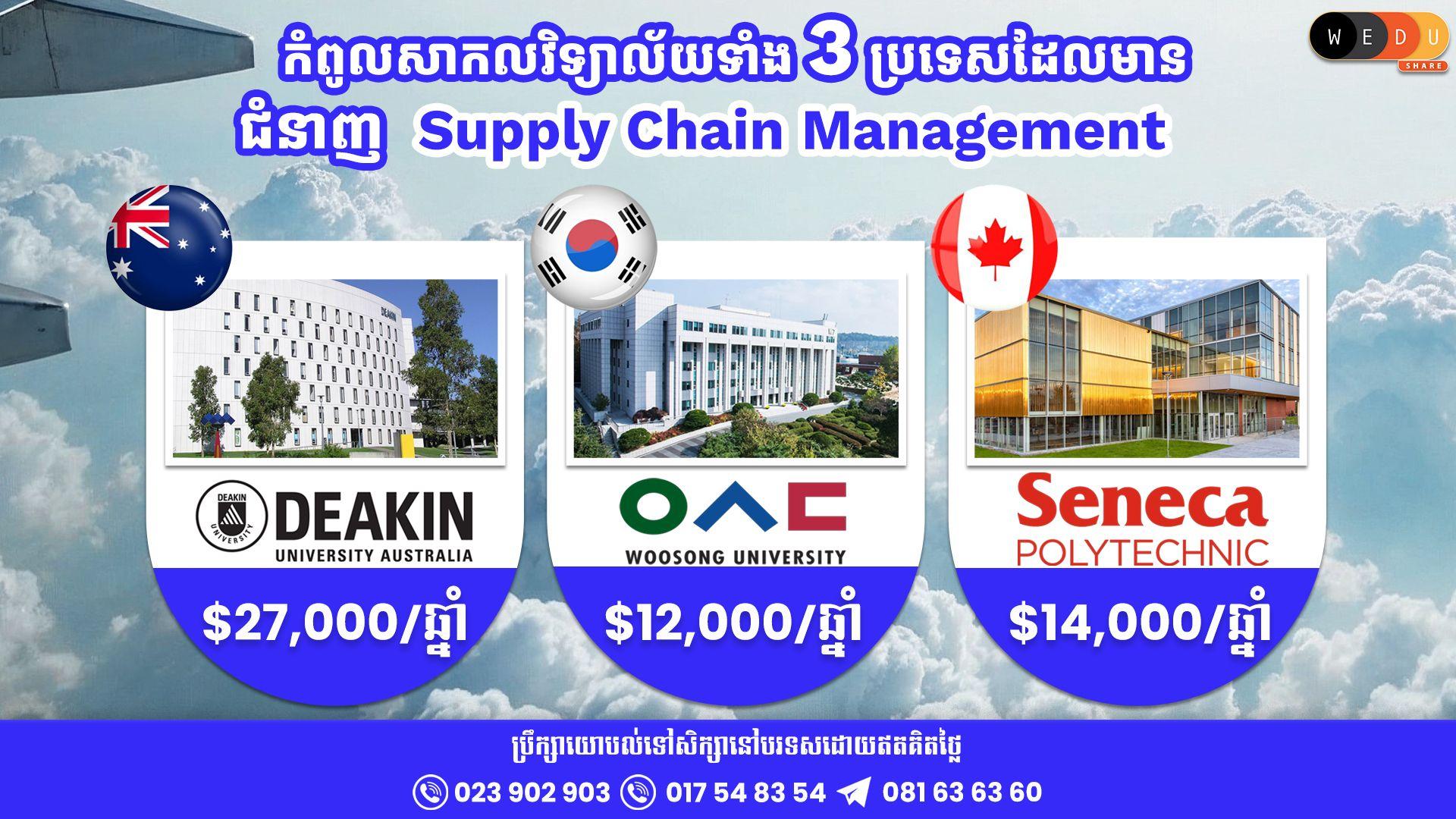
Deakin University
Woosong University
Seneca College
Curtin University
Eligibility Criteria
- Must be an international
- English language proficiency: Meeting the minimum English requirement (IELTS, TOEFL, or equivalent) is mandatory.
Fees
Curtin University: $19,000-$32,000/Year
Deakin University: $20,000-$27,000/Year
Woosong University: $7,000-$12,000/Year
Seneca University: $10,000-$14,000/Year